Insights Board
Where individual customer interviews turn into segment-level knowledge — the patterns across everything you've learned.
What it is
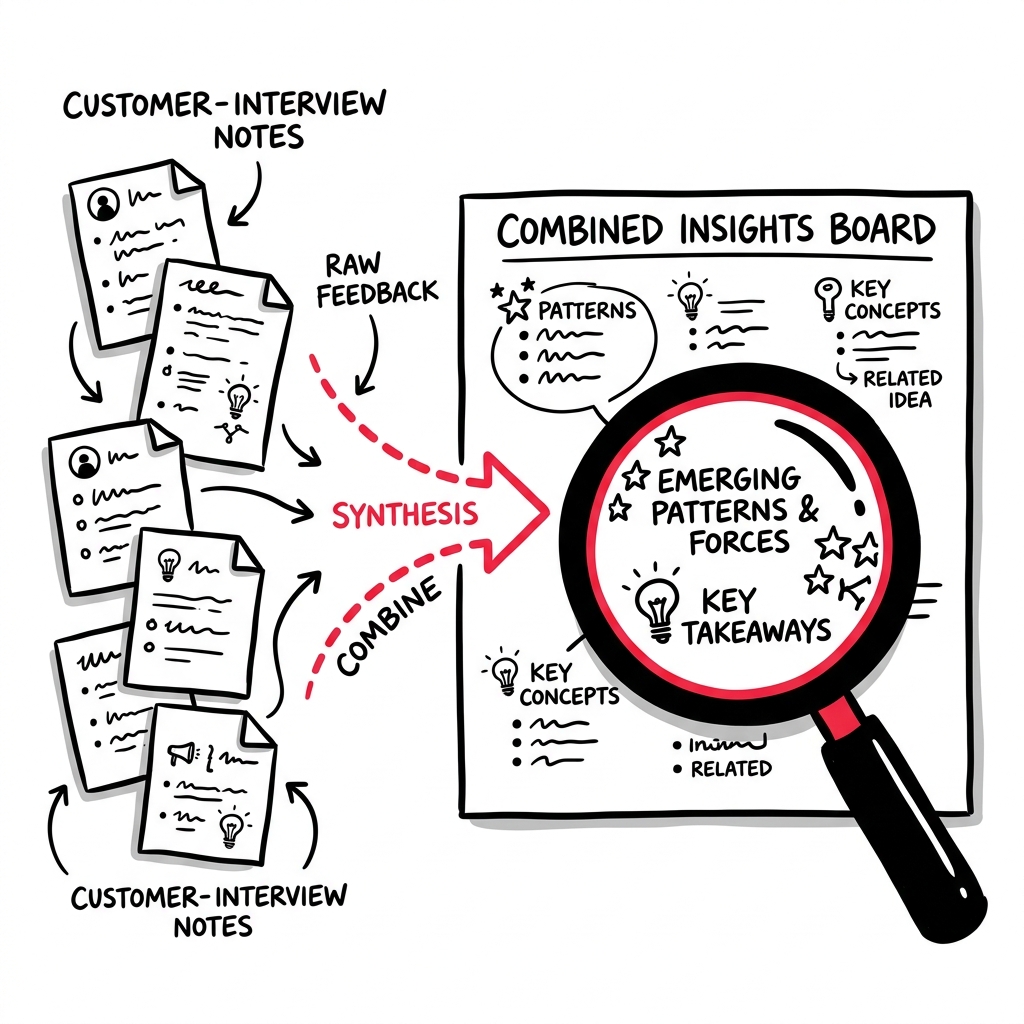
The Insights Board is the founder-level aggregation of everything you’ve learned from customer interviews — across all your ideas, segments, and sprints. A single interview tells you about one person. The Insights Board shows you the patterns: which forces show up repeatedly, which segments cluster on which jobs, where the customer language is converging or splitting. It’s where individual conversations turn into segment-level knowledge.
Where it lives
- Top-level surface at
/insights. - A per-idea view at
/business_models/:id/insightsfor a single business model’s segment picture.
How to use it
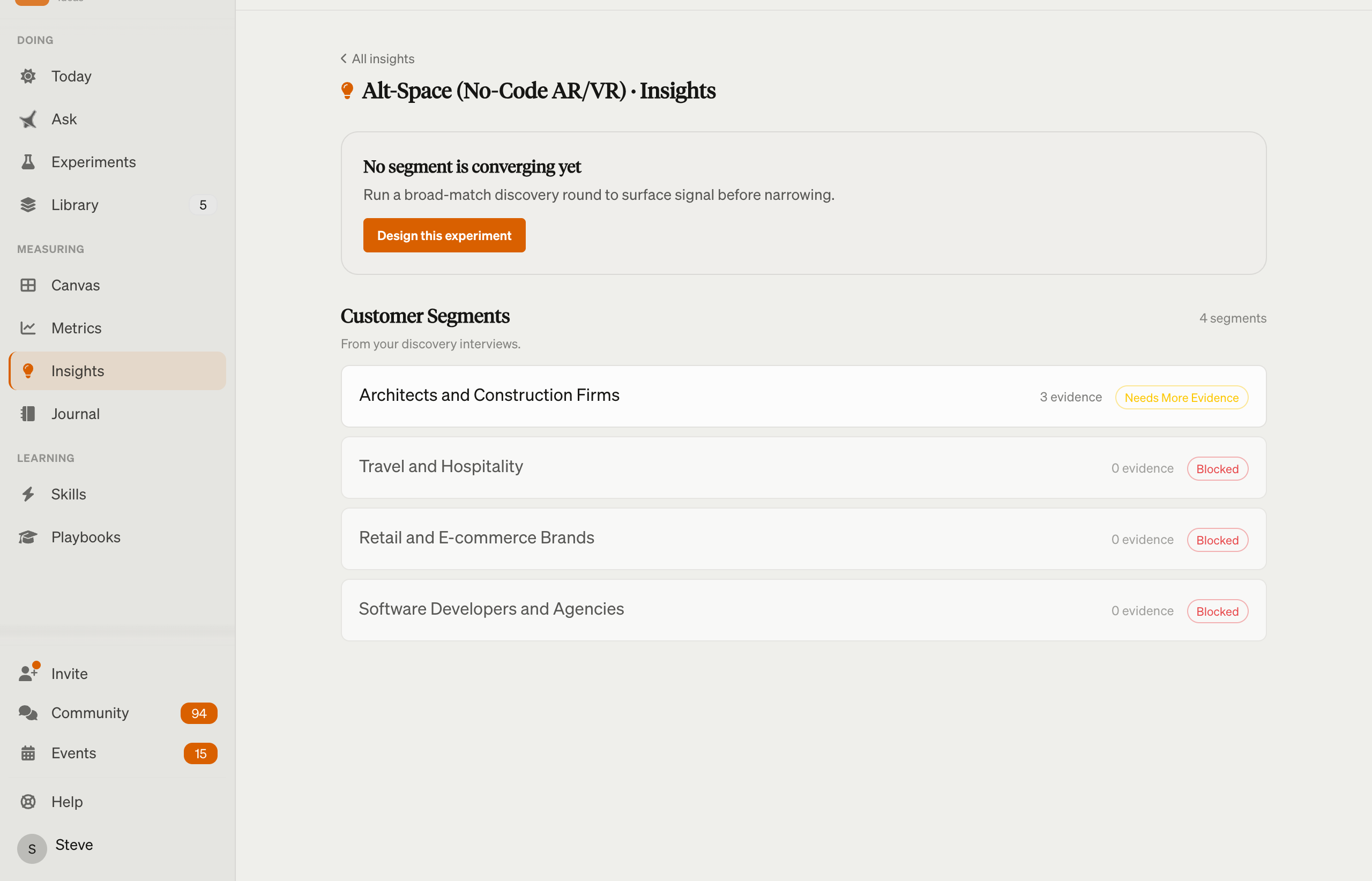
Open it once you’ve recorded several interviews and want to see what’s emerging — especially when you’re choosing a beachhead segment and need to see which one has the strongest, most consistent forces, or when you’re rewriting a canvas block and want to ground the new language in what customers actually said.
You don’t have to wait for synthesis. The per-idea page pays off the moment one interview lands:
- Per-interview value card — as soon as an interview finishes processing, its card shows the top push force and a summary. That’s the immediate “the product read my conversation” moment.
- Corpus-state narrator — an honest read of where your evidence stands: “signal, not proof” when the corpus is thin, “keep prospecting” mid-way, “ready to commit narrow” once enough interviewees converge.
- First-pattern celebration — a one-time marker the first time a segment crosses the evidence bar.
It consumes every interview you’ve recorded and the segments they’re attached to, and produces the segment-level views that tell you which canvas block to update and which experiment is worth running next.