
The AI tools that help most with early-stage startup validation do four jobs. A Lean Canvas coach such as LEANSpark helps you model the idea and stress-test it. An AI search tool such as Perplexity helps you research the market. Interview analysis helps you learn from customer conversations, and landing page and payment tools test whether customers will commit. AI speeds up every step, but the evidence still has to come from real customers.
A model predicting that people will love your product is a hypothesis, not evidence. So the useful question is not which AI tool is best, but which one gets you real customer evidence faster at the stage you are in. In this guide I answer that stage by stage, using the Running Lean method, which is my step-by-step process for testing an idea.
What is startup validation?
Startup validation is the work of testing your riskiest assumptions with real customers before you spend months building. Every new idea rests on a few beliefs that have to be true, such as who the customer is, what problem they have, and whether they will pay. Validation turns those beliefs into evidence, one at a time, starting with the riskiest.
AI startup validation is the same work with AI doing the heavy lifting. AI speeds up the research, the analysis and the building, but the evidence still has to come from customers.
The trap AI makes worse
AI made building cheap, so founders rush to build. You can now ship a working product in a weekend, which makes it tempting to skip the step where you find out whether anyone wants it.
That step matters more than ever. When anyone can build anything, the scarce thing is knowing what is worth building. A polished prototype tells you whether people can use your solution, but it tells you almost nothing about whether the problem is worth solving.
That is why I put problem discovery and willingness to pay ahead of prototype quality.
Early-stage AI tools for startup validation, by stage
Here is how I map the tools to each stage of the method. Each stage asks a different question, and each has a different kind of evidence that counts as an answer.
| Stage | The question | Evidence that counts | Tools that help |
|---|---|---|---|
| 1. Model the idea | What must be true for this to work? | A Lean Canvas with the riskiest assumptions named | LEANSpark, ChatGPT, Claude |
| 2. Stress-test it | Is the model plausible before I talk to anyone? | A model that holds up on paper, with its weakest dimension flagged | LEANSpark, ChatGPT or Claude (ask it to argue against you) |
| 3. Research the market | What do people use today, and where do they complain? | Existing alternatives and the words customers use | Perplexity, ChatGPT, Claude, Gemini |
| 4. Customer discovery | Do real customers have this problem, and how badly? | Stories of what customers actually did, in their words | LEANSpark, Dovetail, Granola |
| 5. Test the offer | Will customers commit to what you’ll sell, at your price, before it is built? | Pre-orders, deposits, signed pilots | Unbounce, Carrd, Stripe |
| 6. Build the smallest product | Can we deliver the promise? | Customers getting the outcome they paid for | Lovable, Bolt.new, Replit, Cursor, Maze (usability tests) |
| 7. Measure | Do customers stay and pay? | Activation, retention and revenue | PostHog, Mixpanel, Stripe |
Some of these are AI assistants and some are built for one job. A few, like Stripe and Carrd, are plain tools that turn an experiment into numbers you can trust.
What each tool is best for
- LEANSpark is best for keeping the chain of evidence from your Lean Canvas to your customer interviews to your next decision.
- ChatGPT and Claude are best for brainstorming, and for arguing against your idea when you ask them to.
- Perplexity is best for researching existing alternatives and the words customers use.
- Dovetail is best for teams organizing a large library of customer research.
- Granola is best for capturing meeting notes without a bot joining the call.
- Unbounce and Carrd are best for a quick landing page that tests an offer.
- Stripe is best for taking deposits and pre-orders.
- Lovable, Bolt.new, Replit and Cursor are best for building a prototype once customers have committed.
- Maze is best for usability tests on a prototype.
- PostHog and Mixpanel are best for measuring activation and retention.
How I chose these tools
I picked these by the job they do at each stage. Nobody paid to be on this list. LEANSpark is my product, which is why I spell out below what it does and what it doesn’t do.
Customer discovery AI: where it helps and where it hurts
Customer discovery is the hardest part to get right. It is where AI helps most when used well, and hurts most when used badly.
Where AI helps. It can help you find people who have the problem, and prepare questions about their past behavior instead of their opinions. It can transcribe and analyze each conversation, and spot patterns across many interviews. It can also give you feedback on how you interviewed, such as where you started pitching or asked a leading question.
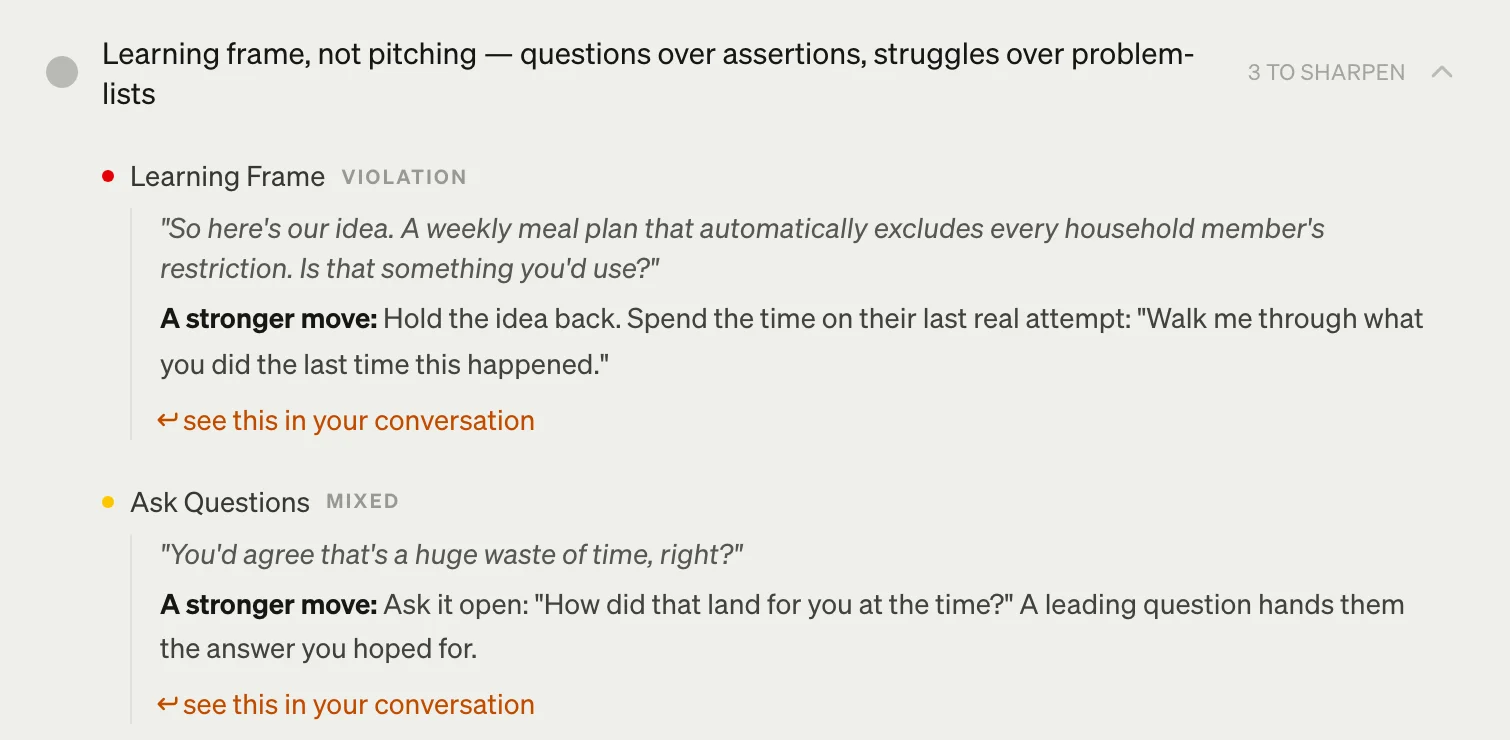
Where AI hurts. It can generate fake customers that tell you what you want to hear. Simulated interviews feel productive, but they produce no evidence. Practicing against a simulation built from real recorded interviews can sharpen your technique, but it is still not evidence. Use AI to get better at talking to customers, not to avoid talking to them.
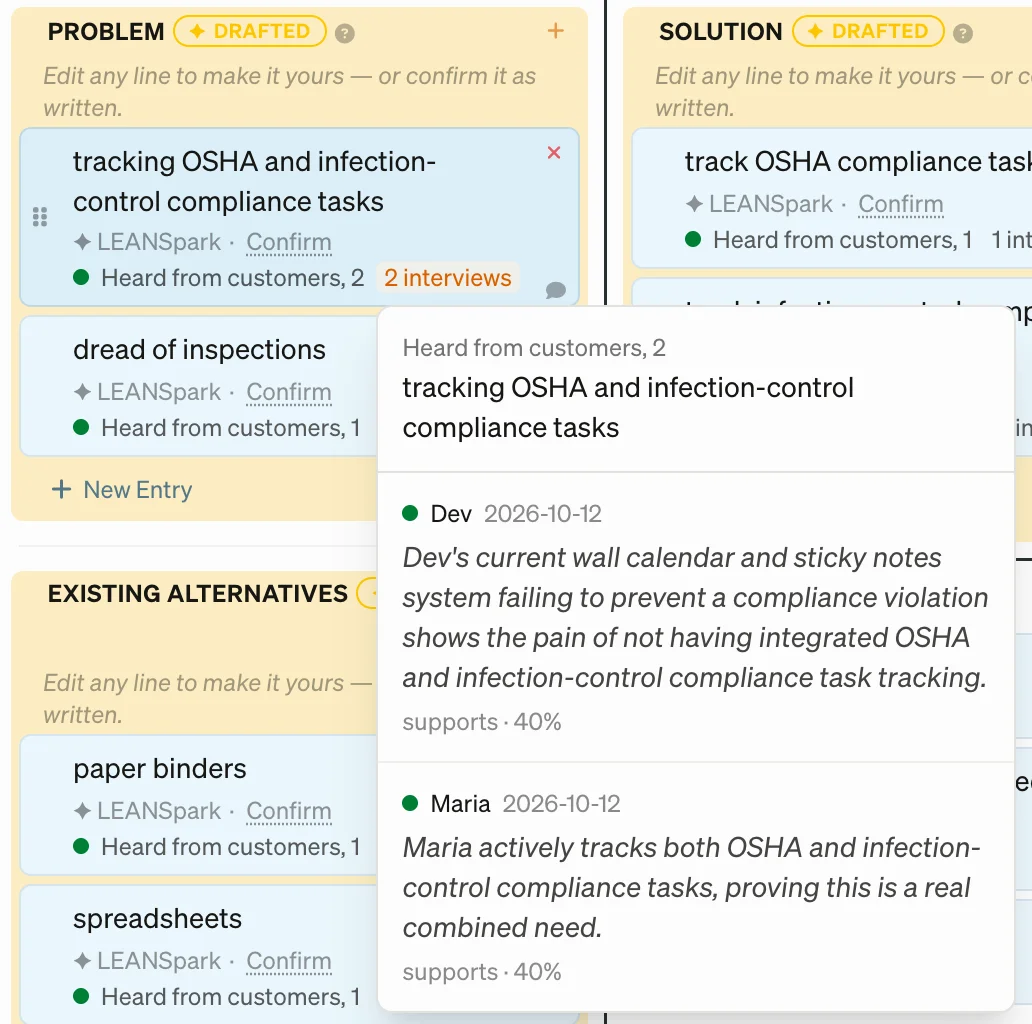
What good looks like. Every insight traces back to the conversation it came from. When you claim that customers struggle with something, you can open the interview and hear them say it.
Not all evidence is equal
The most common mistake I see is treating every signal as proof. I think of your Lean Canvas as a ladder of beliefs, where each rung takes stronger evidence than the one below it.
A guess starts as a leap of faith. It becomes plausible once it survives a stress test on paper. It earns qualitative evidence from customer interviews, and then quantitative evidence from what customers do, such as signing up or paying. An AI’s prediction about your customers is not a rung on this ladder at all.
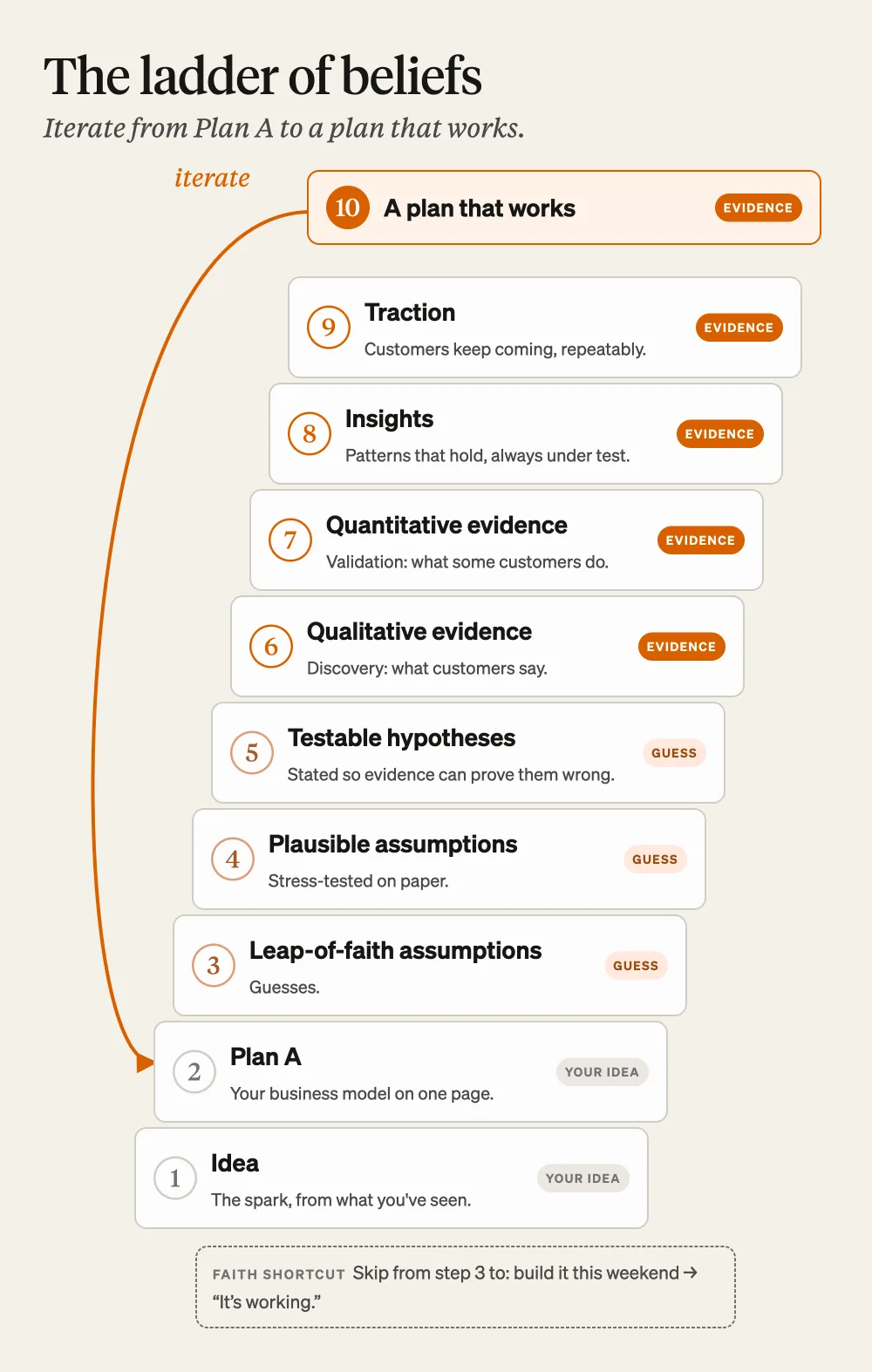
Every assumption on your canvas should only move up the ladder when customers back it. I wrote about the full ladder in Your Lean Canvas Is a Ladder of Beliefs.
Where LEANSpark fits
Most AI tools speed up one activity, such as research, transcription or building, but they don’t keep the chain of evidence from your first assumption to your next decision.
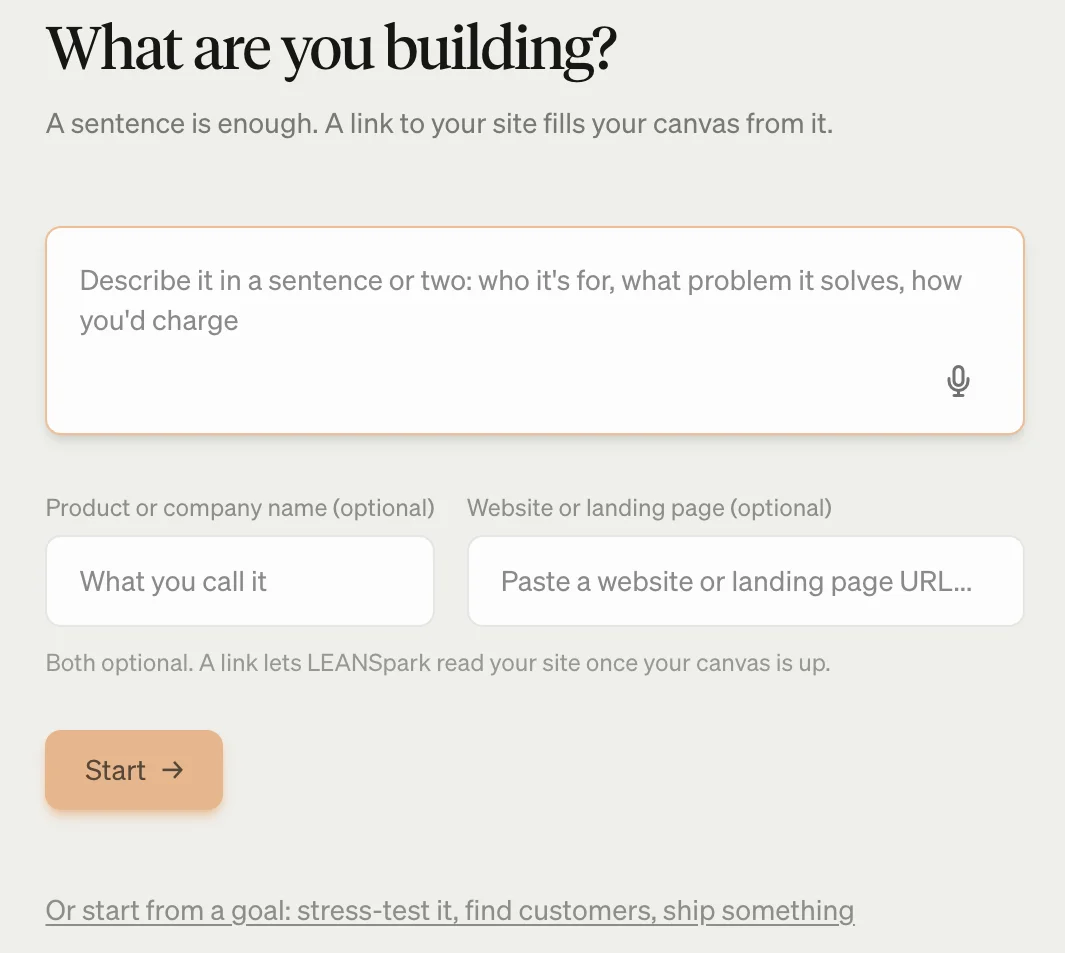
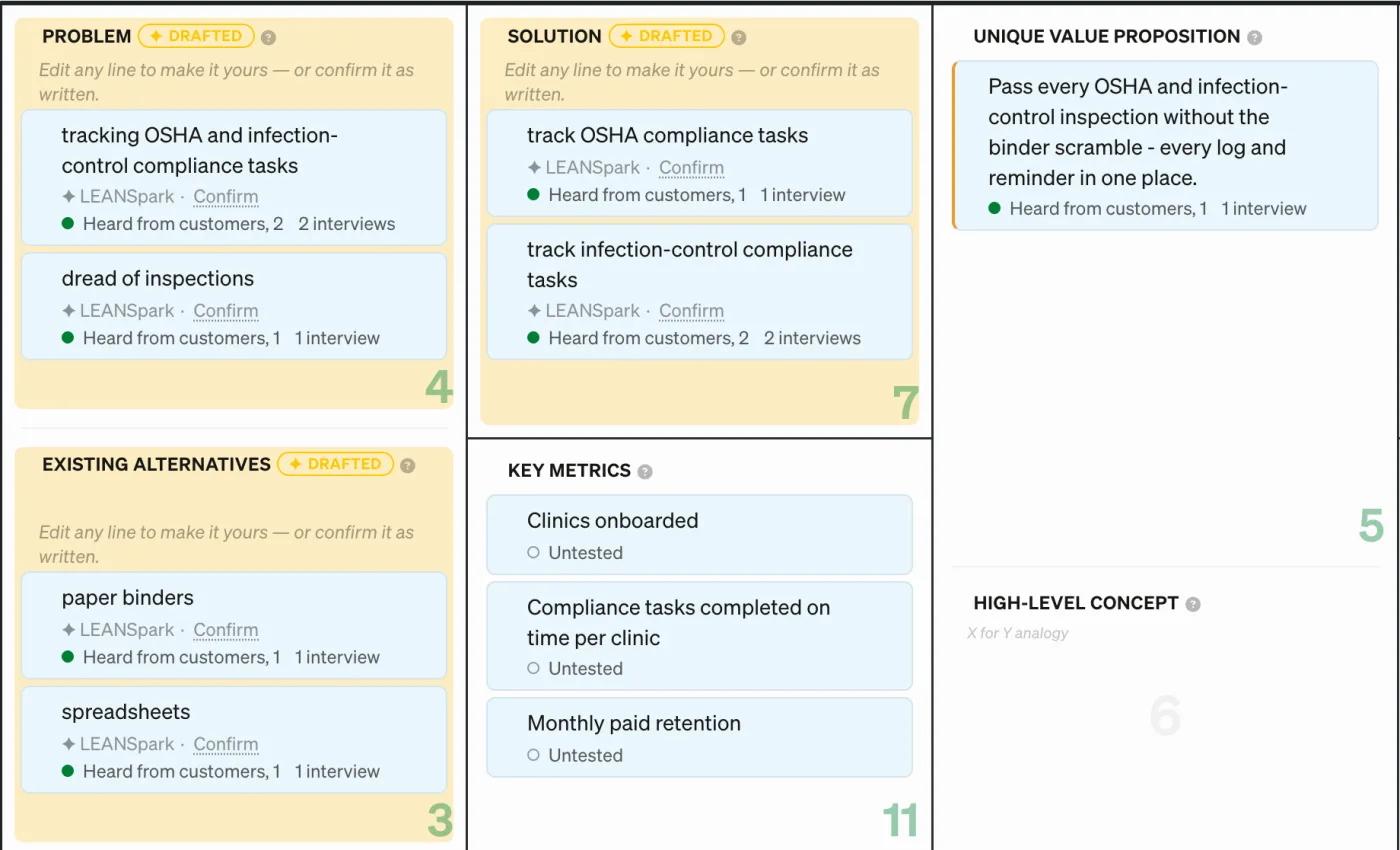
That is the gap I built LEANSpark to fill. It runs the Running Lean method with you on your own idea. You describe the idea in a sentence, or paste a link to your site, and LEANSpark drafts your Lean Canvas.
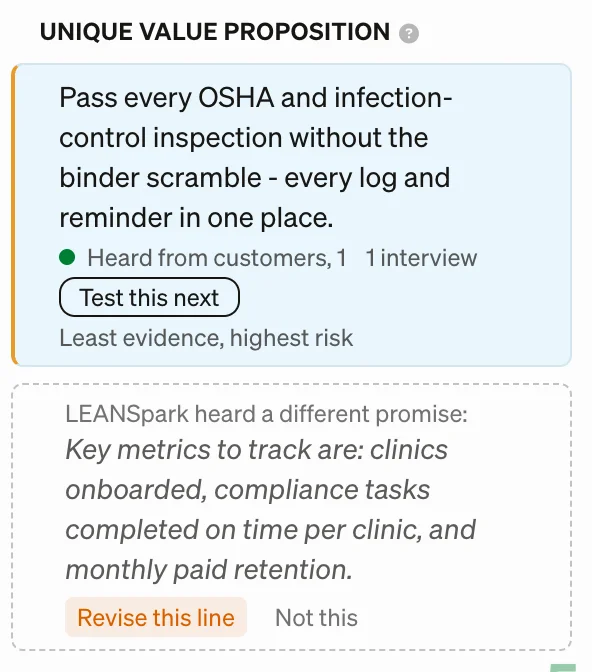
You stress-test the model before you talk to anyone. Then you bring your customer interviews back for analysis, and the evidence lands on the canvas, linked to the conversation it came from. You also get feedback on how you interviewed, with each point tied to the exact moment in the transcript. From there you plan each next experiment from what customers actually said, all the way to the offer you take to your first paying customers.
LEANSpark does not replace a landing page builder, a payment processor or an app builder. It is the place where the evidence from all of them adds up to a decision.
Your first two weeks
If you are starting from an idea today, here is how I would spend the first two weeks.
- Model it. Put the idea on a Lean Canvas and name your three riskiest assumptions.
- Stress-test it. Fix the weakest dimension, such as clarity, desirability, viability or feasibility, before you spend time in the field.
- Research it. Use an AI search tool to map existing alternatives and the language customers use.
- Talk to customers. Interview people who recently hit the problem and changed what they do about it. Analyze each interview as you go, and stop when new interviews stop changing the stories you hear.
- Decide. Based on what customers said and did, persevere, pivot or stop.
Set your success threshold before each step, so the evidence decides, not your hopes. For a day-by-day version, see Your First 14 Days with LEANSpark.
Frequently asked questions
Can AI validate my startup idea? No tool can validate an idea on its own. AI can speed up research, analysis and building, but validation needs evidence from real customers, such as interviews, pre-orders or payments.
What is the best AI tool for startup validation? It depends on the stage you are in. Use a Lean Canvas coach such as LEANSpark to model and stress-test the idea, an AI search tool such as Perplexity for market research, interview analysis for customer discovery, landing page and payment tools to test the offer, and an app builder only once customers have committed.
Is ChatGPT enough for startup validation? A general chatbot is useful for brainstorming and research, but it tends to agree with you and forgets your work between sessions. For validation you need structure that persists, such as a canvas, stress tests, and interviews captured as evidence.
What are the best early-stage AI tools for founders? Pick tools by the job at your stage. Research tools help before you talk to customers, interview analysis helps during customer discovery, landing page and payment tools test the offer, and app builders help once customers have committed.
What is customer discovery AI? It is AI that helps you prepare, run and learn from customer interviews. Good customer discovery AI analyzes real conversations and links each insight to its source. It does not invent customers for you.
How many customer interviews do I need? There is no magic number. Most markets have three to five recurring stories, so keep going until new interviews stop changing them. Treat it as directional learning, not statistical proof.
Where should I start? Start with your riskiest assumption. If you want the method first, the playbook Is Your Idea Worth Pursuing? is free to read. If you want to run it on your own idea, start free at leanspark.ai.