

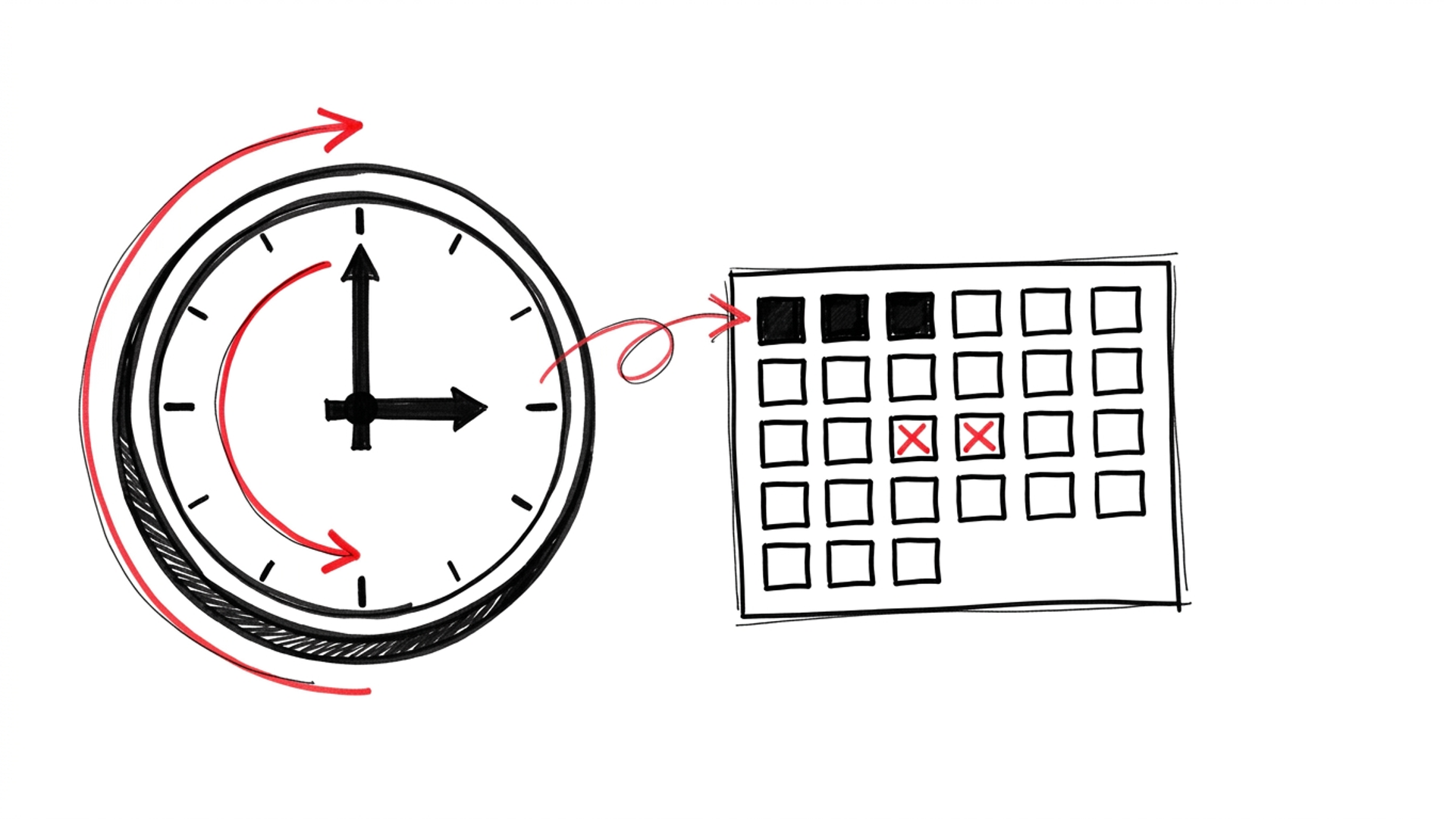
You write down a 90-day plan. You break it into sprints. You pick the first experiment.
Two weeks later, you’re supposed to run a small ceremony — review what landed, adjust what didn’t, advance the sprint. Instead, you find a reason. The week is busy. The data isn’t conclusive yet. You’ll catch up next week.
Procrastination compounds. The cycle drifts. By week six you’re running on inertia, not learning.
If you’ve felt that shape in your own work, you’re not alone. We see hundreds of founders inside LEANSpark hit this same wall — not at the experiment, but at the transition between sprints. They have the canvas, the campaign, the first experiment. The mechanism that’s supposed to advance the sprint waits for them to push a button. They don’t push it.
The fix isn’t more discipline. It’s a different theory of how time should work in a validation cycle.
Time as a container vs. time as a forcing function
Most validation frameworks treat time the same way most calendars do — as a container. You decide when to start. You decide when to advance. You decide when to wrap. Time bends to you.
That sounds founder-friendly. In practice it does the opposite.
When the founder owns every transition, every transition becomes a decision. Every decision becomes a moment to procrastinate. And procrastination — not failure — is what kills most validation cycles.
The reframe: time isn’t a container, it’s a forcing function.
A forcing function is any external constraint that converts a someday-decision into a now-decision. A flight at 7 a.m. forces the packing. A demo on Friday forces the build. The deadline doesn’t help you decide — it makes you decide.
The same logic applies inside a validation cycle. If the calendar advances on the dot, you don’t decide whether to move forward. You decide what you learned in the last fourteen days.
Parkinson’s law does the rest: work compresses to fit the time you actually give it.
Why founders procrastinate transitions (and not the work itself)
Most founders aren’t lazy at the work. They run interviews, ship MVPs, talk to customers. The procrastination clusters at a specific moment — when one block of work ends and the next is supposed to begin.
Three things make transitions hard:
1. The data is never quite “ready.” You always feel like one more day, one more interview, one more iteration would clarify things. So you stall the transition rather than admit you’ve learned what you’re going to learn this round.
2. The next decision feels heavier than it is. Advancing a sprint isn’t actually a one-way door — you can refine, split, or abandon at the next boundary too. But in the moment, it feels final, so you defer.
3. There’s no external cost to deferring. A self-managed sprint doesn’t end if you don’t end it. Nothing happens. The cost shows up weeks later, as drift you can’t trace back to a specific day.
A forcing function neutralizes all three. The boundary fires whether the data is ready or not. The decision becomes “what did I learn?” instead of “is it time?” And the cost of not showing up to the boundary is that the sprint advances anyway, with whatever evidence you have.
What this looks like as a practice
Three rules turn time into a forcing function inside a 90-day cycle:
1. Lock cycles to a calendar boundary you don’t control
The cleanest boundary is the calendar quarter — every founder runs the same dates, every cycle starts on a Monday, every cycle ends on a Sunday thirteen weeks later. But the principle is platform-independent. Pick a recurring boundary you can’t easily move and align your cycles to it.
Why “can’t easily move” is the operative phrase: a boundary you can renegotiate isn’t a forcing function. The point is to give up that flexibility on purpose.
2. Make sprints fixed time slots, not playbook steps
Most founders equate sprints with playbook steps — Sprint 1 is discovery, Sprint 2 is narrow match, Sprint 3 is solution design. The trouble: real experiments don’t respect that mapping. Some discovery work takes one sprint, some takes three. When the playbook says “advance,” reality often says “I’m still learning.”
Decouple them. Sprints are two-week time slots — empty containers. Experiments are the work — variable-length, owned by campaigns that span multiple sprints.
When the boundary fires, the experiment doesn’t have to be done. It just has to be reflected on. The default action is “continue with what we learned this sprint.”
That decoupling is what lets you run multiple campaigns in parallel — say, a Mafia Offer campaign and a content-marketing campaign in the same two-week window — without the schedule collapsing.
3. Force a renewal conversation at every cycle boundary
For every active campaign, force a four-way decision at the end of each 90-day cycle: continue, pause, complete, or abandon. No defaults. No “we’ll see.”
Inertia is what turns a 90-day cycle into a 270-day cycle that nobody can audit. Campaigns that can’t survive a “is this still paying off?” conversation shouldn’t carry over. The renewal conversation is what turns inertia off.
What the grid looks like
The structure is deliberately boring.
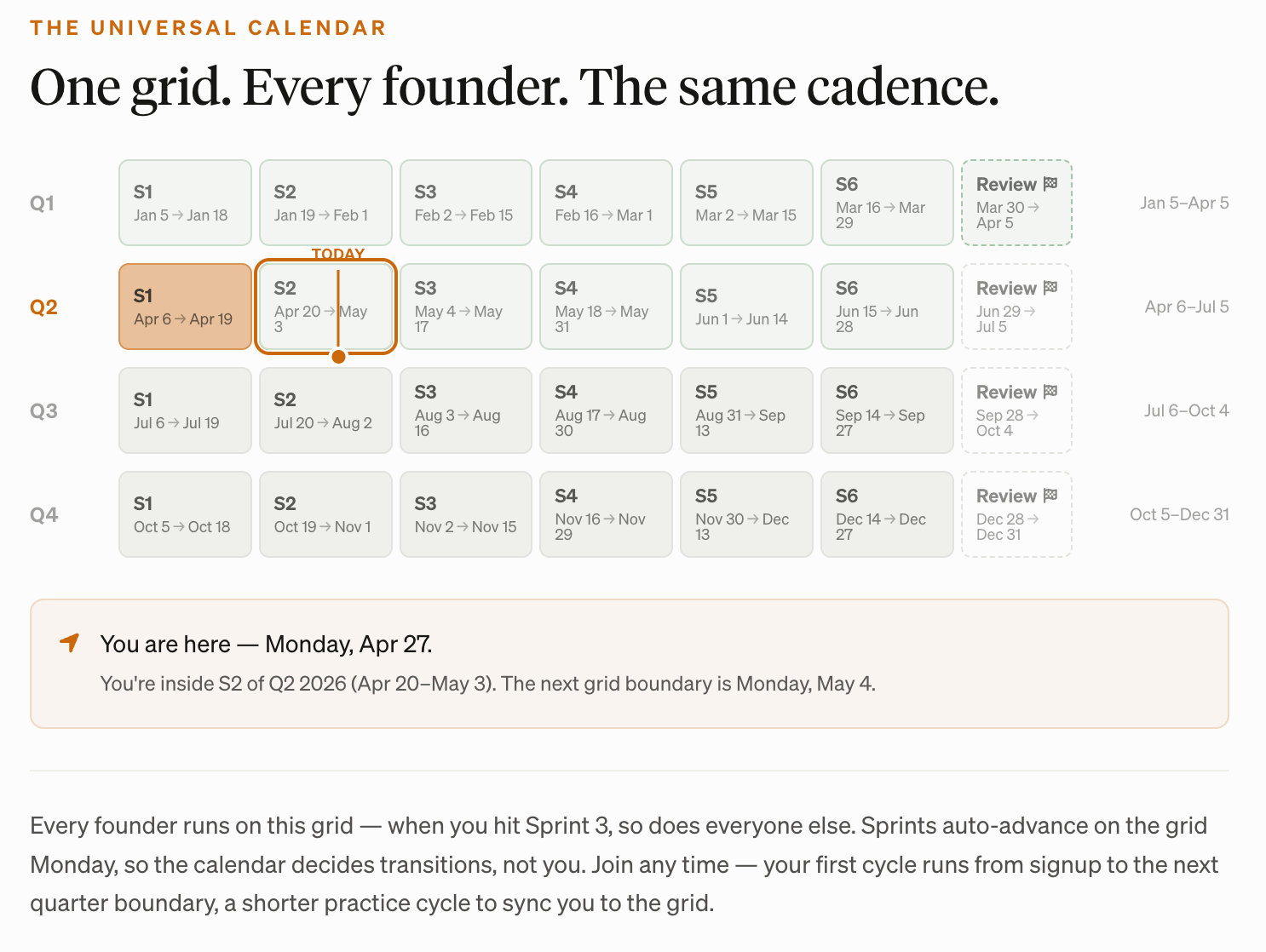
One grid. Every founder. The same cadence.
Six 2-week sprints plus one review week is 13 weeks, which is 91 days, which is the actual length of a calendar quarter. The review week is for the retrospective and the next-cycle setup — no new work scheduled there. It’s structural rest with a purpose.
The grid does a lot of quiet work. It tells you the boundaries are real. It tells you exactly when the next forcing function fires. And it makes the question “should I advance?” disappear, because the answer is “the calendar already did.”
The objections, answered honestly
“What if I’m not ready when the quarter starts?” Join the quarter that’s running. Your first cycle might be six weeks instead of thirteen. Treat it as a practice run. Your next cycle is a full thirteen — and by then you’ve already absorbed the rhythm.
“What if my experiment isn’t done at the sprint boundary?” Most experiments aren’t. The default action at every boundary is continue — the experiment carries forward. The boundary doesn’t kill the work. It forces a conversation about what you learned in the last fourteen days. That conversation is the point.
“Won’t I feel rushed?” Probably. That’s the trade. Most founders aren’t suffering from too little time — they’re suffering from too few decisions. A fixed deadline compresses decisions. Compressed decisions surface the constraint. The constraint is what you came here to find.
“What if I’m a side-project founder with two hours a week?” The cadence is the same; the work density is yours to set. A 2-hours-a-week founder running on the calendar still gets the same biweekly forcing function — they just run smaller experiments inside it. The pace adapts. The structure doesn’t.
How this works inside LEANSpark
Inside LEANSpark, calendar cycles run on autopilot:
- Every founder lands on the current quarter at signup. The Universal Calendar above is the actual onboarding view — you can see exactly where you sit on the grid before you commit to anything.
- Sprints auto-advance at midnight in your local timezone on the boundary day. There’s no button to push.
- At each sprint boundary, every active experiment surfaces a short reflection prompt: Continue, Split, Complete, or Abandon? The default is Continue, with this sprint’s learnings appended.
- Multiple campaigns can run in parallel — useful when your traction work and your content work both need to ship in the same two weeks.
- At the cycle boundary, the renewal conversation fires automatically for each active campaign. Don’t renew? It auto-pauses. Inertia is off by default.
The methodology underneath — Continuous Innovation, Lean Canvas, problem/solution interviews, mafia offers, traction roadmaps — is unchanged. What’s different is the timing layer that runs underneath it.
The takeaway
Validation programs don’t fail because founders don’t know what to do. They fail because founders carry the timing — and humans procrastinate transitions.
Take the timing off the founder. Put it on the calendar. The work that compounds on top of that is yours. The procrastination that used to compound on top of it isn’t.
The next sprint boundary fires Monday. Ready or not.
That’s the point.
If you want the structural argument for why 90 days is the right cycle length to begin with, start with The 90-Day Validation Cycle.