

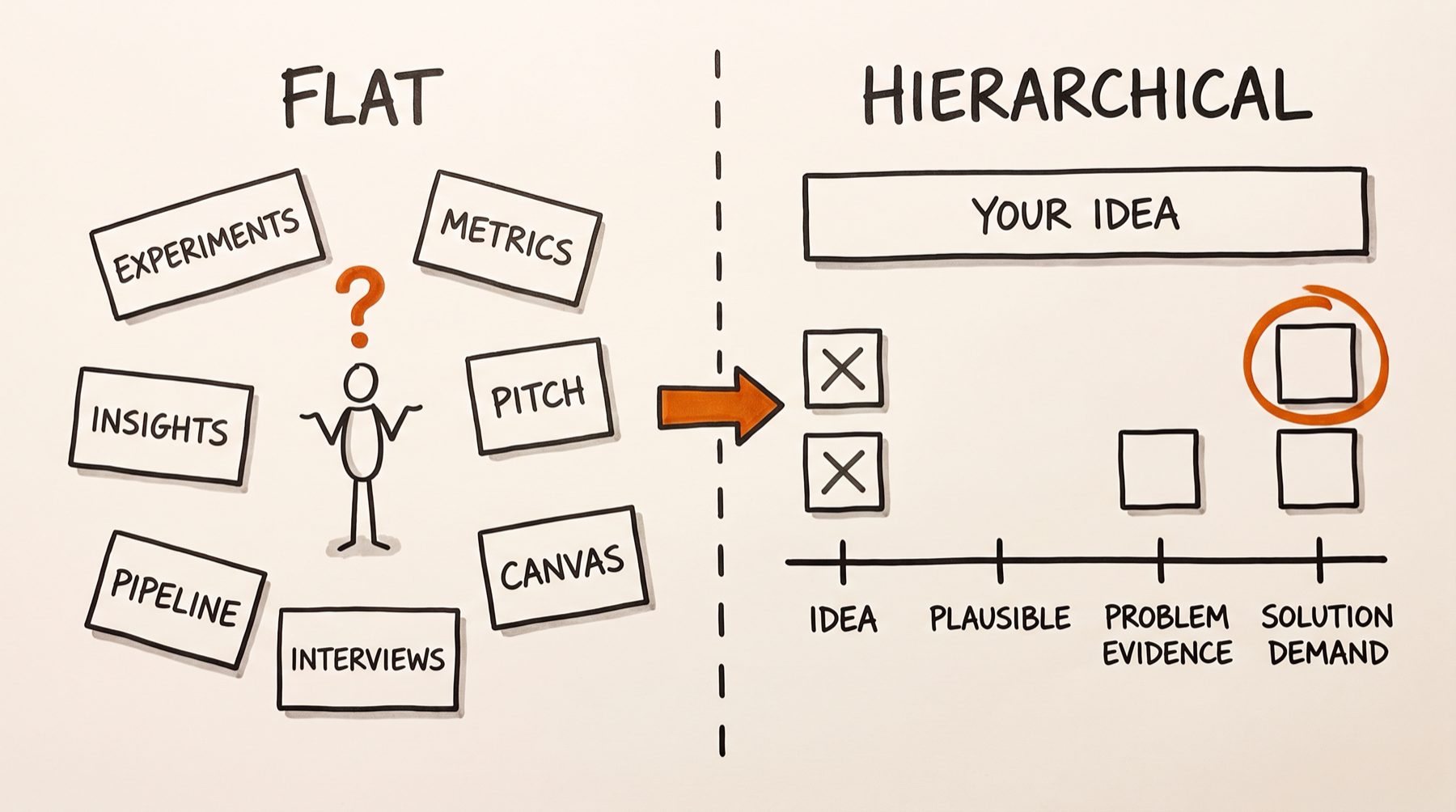
Every tool I build gets complicated before it gets simple.
The Lean Canvas started as one page, grew into a traction roadmap and a forces model and a validation plan and a scorecard, and eventually collapsed back into three mental models. LEANSpark started as one chat agent, grew to seven-plus surfaces, and this week it collapsed too.
Five surfaces left the top level: Experiments, Metrics, Insights, Pitch, Pipeline. They are not gone. They are doors on the bet they belong to. Your idea sits at the top, every variant you are running sits on one rail underneath it, and you drill into whichever one you are working on.
Here is what that actually buys you.
You can see your whole idea in one look
Open Journey and every variant you have is on screen, each one sitting at the stage its evidence has earned. Idea, Plausible, Problem evidence, Solution demand, Solution validation.
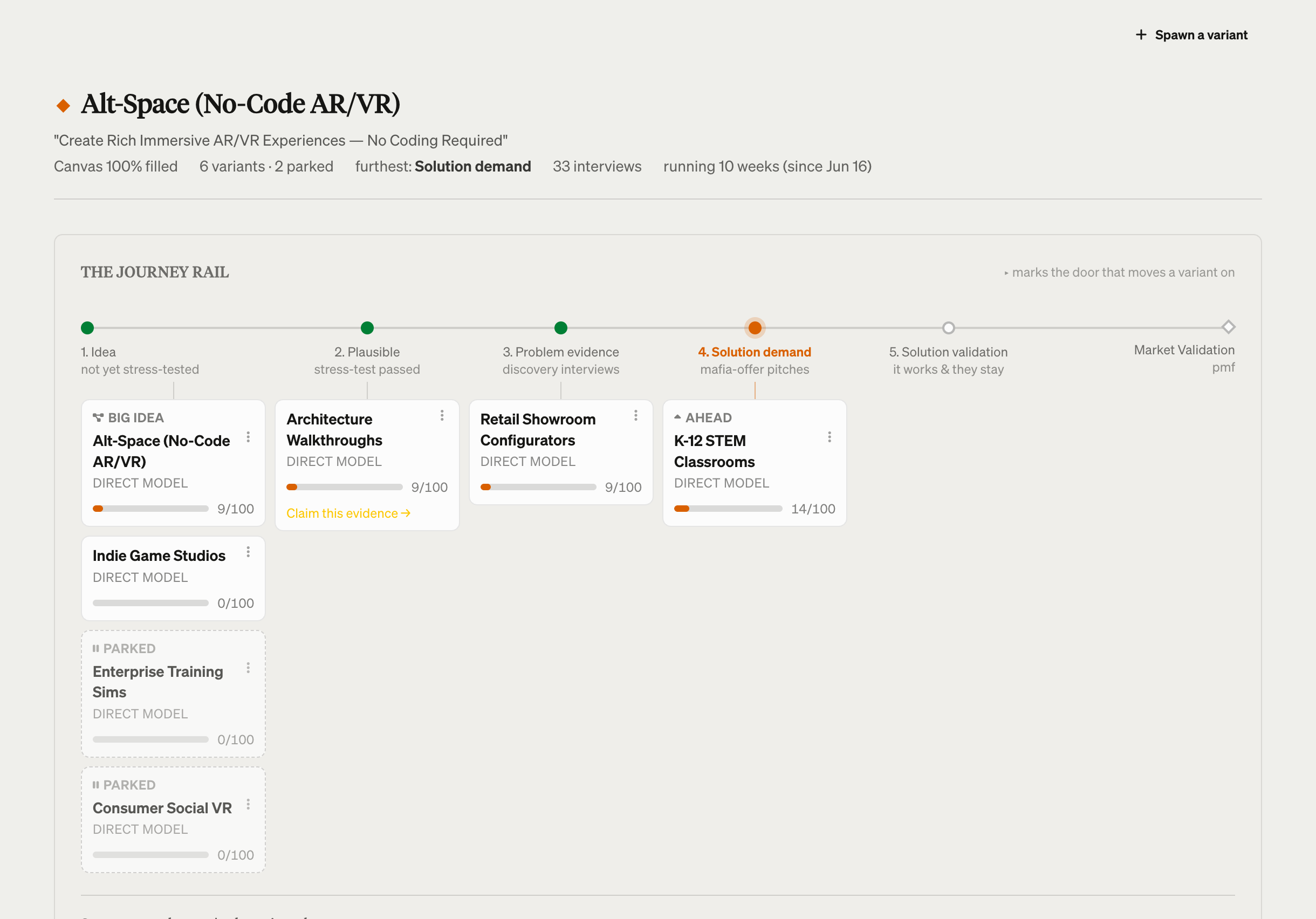
No dropdown, no picking, no clicking. Your situation is the first thing you see, not something you assemble from four visits.
Which means you can finally compare them
This is the one that matters, and it is the one a flat structure quietly made impossible.
Validation is not testing an idea. It is taking one Big Idea, deconstructing it into specific variants, and finding out which variant deserves your next two weeks. That decision is a comparison. It cannot be made one screen at a time.
When your variants live behind separate visits, you do not compare them. You work on whichever one you happened to open, and the one you opened is usually the one you already liked. That is not validation, that is confirmation with extra steps. Months of effort go to the variant with the best story rather than the variant with the best evidence, and nothing in the app ever tells you, because the app never showed you both.
Put them on one rail and the comparison makes itself. Two variants at Problem evidence and one still at Idea is a resourcing decision you can make in five seconds. So is one at Solution demand while three sit parked.
Your evidence lands where it counts
Every interview, experiment and insight now belongs to a variant, and you reach it by going through that variant.
That sounds like filing. It is actually about whether progress accumulates. Evidence that is scoped to a variant moves that variant’s stage. Evidence floating in a global list moves nothing. When the structure matches, doing the work and seeing the progress become the same action instead of two.
And when something lands on the wrong variant, you can move it now. The analysis that carries over is preserved, and the parts that do not carry are re-run against the variant it lands on.
You spend your time deciding instead of navigating
The test I should have run on myself a year ago: count the decisions between opening your product and seeing your own situation.
More than one and you have a filing cabinet, not a tool. I had seven. Now there is one, and it is not really a decision.
Why the sprawl happens anyway
Every one of those seven surfaces was justified. That is what makes this trap hard to see from inside it. A founder asks for something real, you give it a home, and the home is the right call in isolation. Do that five times over a year and you have shipped a curriculum instead of a tool, without a single wrong decision along the way.
You cannot skip that phase. I have tried. You do not know the right hierarchy until you have built the flat version and watched someone get lost in it.
What you can do is run the count, regularly, on your own product.
Try it
Open Journey. Every variant you are running should be on screen with its stage, without you clicking anything.
Then ask the question the layout now lets you ask: given all of them side by side, which one gets your next two weeks?
Until next time, take care.